
Dental Crowns in Cherry Hill, NJ
At 🍒 Cherry Hill Dental Smiles, we provide high-quality custom dental crowns designed to restore teeth that are cracked, weakened, worn down, or heavily filled. A crown is a durable, natural-looking “cap” that covers your tooth to protect it, strengthen it, and restore your bite and smile.
Dr. Deepika Reddy combines precision dentistry with a boutique, patient-centered experience—so you feel confident in both the process and the final result.
What is a Dental Crown?
A dental crown is a custom restoration that fully covers the visible portion of your tooth. Crowns are commonly used to:
• Protect a weak or cracked tooth
• Restore a tooth with extensive decay
• Repair a tooth with a large filling that is failing
• Strengthen a tooth after root canal therapy
• Improve the shape, size, and appearance of a tooth
• Restore chewing comfort and bite stability
• Crowns are designed to look and feel like your natural teeth, blending seamlessly into your smile.
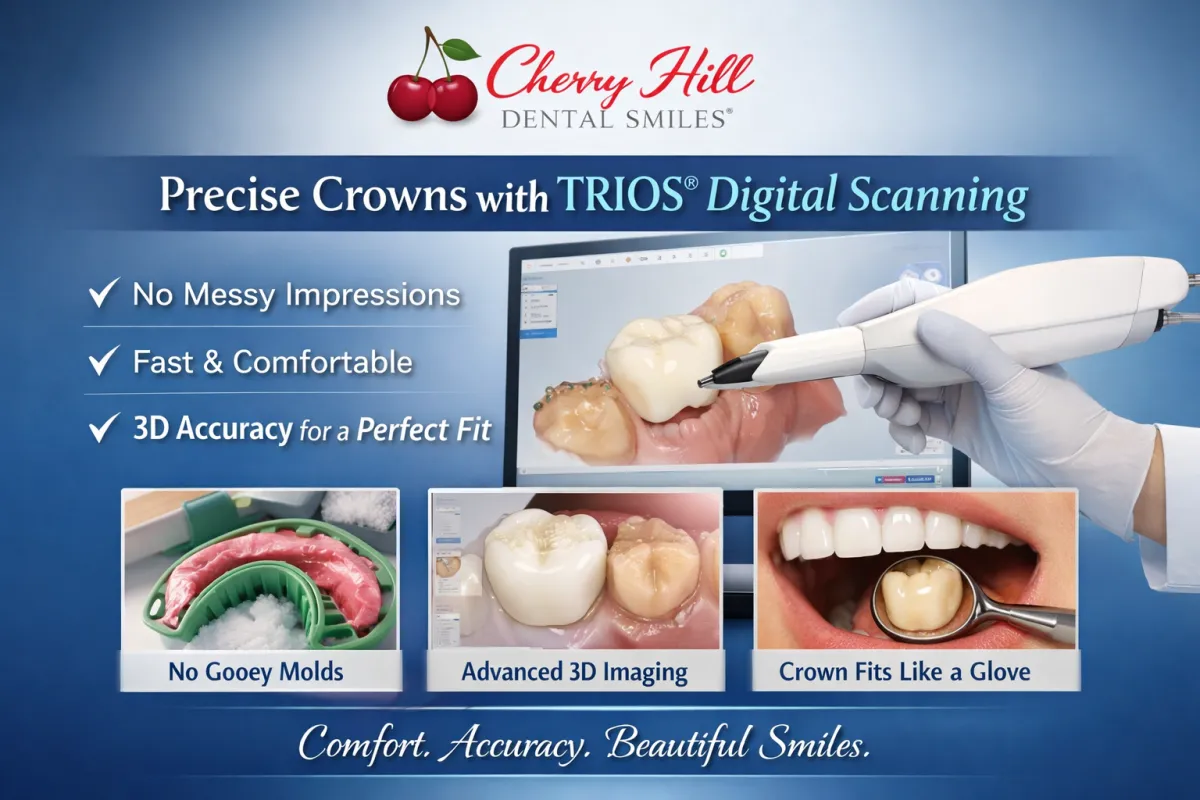
Digital Crown Impressions with the TRIOS Scanner
At our office, we use advanced digital technology to make your crown process more comfortable and more accurate. Instead of using traditional impression material (the “gooey” putty many patients dislike), we take your measurements using a TRIOS intraoral scanner.
This means we can capture a highly detailed 3D image of your teeth in minutes—without mess, gagging, or discomfort.
Why patients love digital scanning
Digital impressions are a modern alternative to traditional molds, and they offer major benefits:
✅ No messy impression trays
No thick material sitting in your mouth, and no uncomfortable gag reflex triggers.
✅ Fast and comfortable
The TRIOS scanner captures detailed images quickly, making the appointment smoother and easier.
✅ More accurate crown fit
Traditional impression material can slightly distort or shrink as it sets. That may affect the final crown fit and can lead to extra adjustments.
With digital scanning, your crown is designed using precise measurements—helping your final crown fit more naturally and comfortably.
✅ No mailing impressions that can change shape
With older methods, impressions often have to be shipped to a dental lab. During that process, physical impressions may shift or shrink slightly, which can affect accuracy.
With our TRIOS scanner, your digital scan is sent quickly and securely to the lab—without the risk of impression material changing over time.
⸻
How Your Crown is Made
After we scan your tooth, the dental lab uses the digital impression to create your crown with advanced technology. The scan is used to produce a highly accurate model, and in many cases the lab can even create a 3D printed model based on your scan.
This helps ensure the crown is designed with precise detail—so it fits comfortably, functions properly, and looks natural.
A fit that feels like a glove
Because the scan is so accurate, crowns created from digital impressions often fit extremely well, with fewer surprises and fewer delays.
In rare cases, a mild adjustment may be needed—and if that happens, Dr. Reddy can typically make that adjustment right in the office the same day your crown is placed, so you leave with a comfortable bite and a confident smile.
What to Expect During Your Crown Appointment
Your crown process typically includes:
1. Evaluation & imaging
We examine the tooth and confirm a crown is the best option.
2. Tooth preparation
The tooth is gently shaped so the crown can fit properly.
3. Digital scan with TRIOS
We take a quick 3D scan instead of using traditional impressions.
4. Temporary crown (if needed)
Your tooth stays protected while your final crown is being made.
5. Crown placement
Your final crown is bonded into place and your bite is checked for comfort.
⸻
Benefits of Dental Crowns
A dental crown can help you:
• Protect a damaged tooth from worsening
• Restore comfortable chewing
• Improve appearance and confidence
• Support long-term tooth strength
• Prevent fractures and future dental emergencies
⸻
Schedule Your Crown Consultation
If you have a cracked tooth, pain when chewing, or a filling that keeps breaking, a crown may be the right solution. At 🍒 Cherry Hill Dental Smiles, we’re proud to offer boutique dentistry with modern technology—including TRIOS digital scanning for a better patient experience.
📞 Call today or request an appointment online to see Dr. Deepika Reddy in Cherry Hill West.
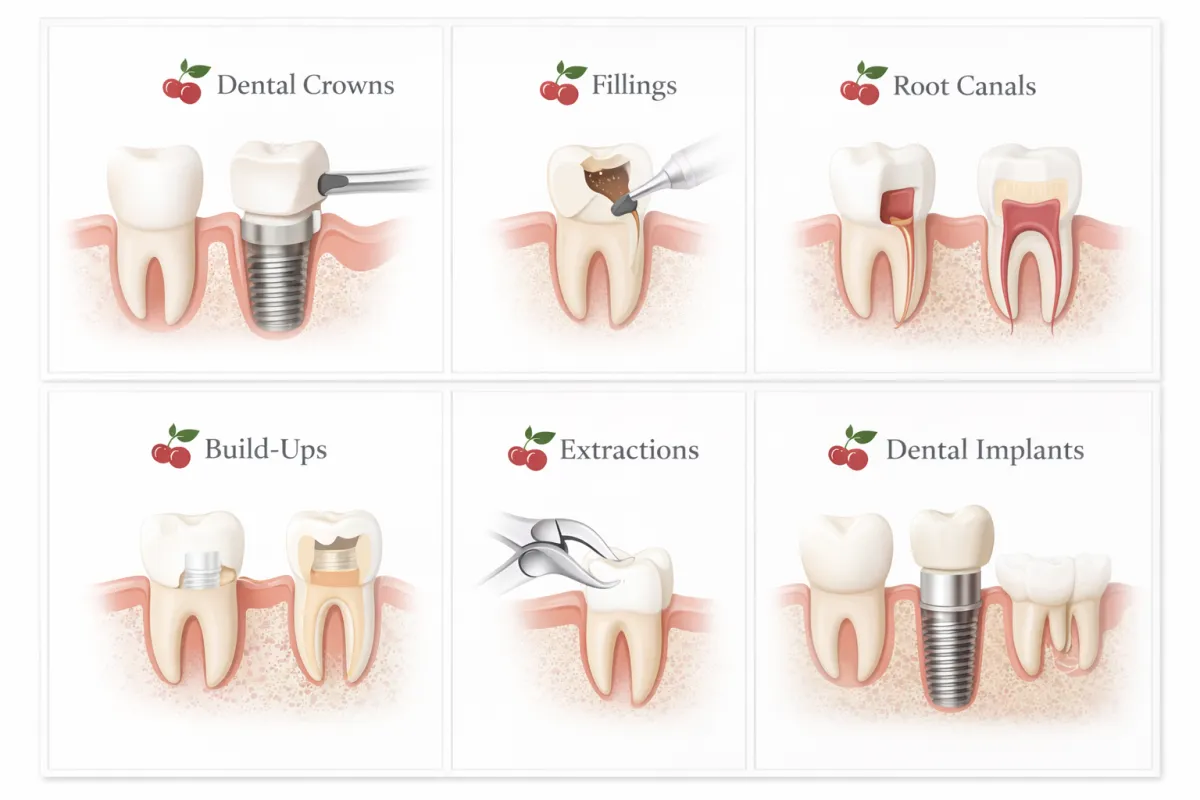
Dental Bridges
A dental bridge is a tooth replacement that typically consists of two dental crowns linked together by a pontic or false tooth. A traditional bridge is supported by the two surrounding teeth, known as abutment teeth, that we reshape to receive the crowns. A bridge can also be supported by a series of dental implants if multiple adjacent teeth are missing. If you are missing a tooth, a bridge will prevent the remaining teeth from shifting out of their proper position.
Dental Implants
A dental implant is a small titanium post that we surgically embed into the jawbone. The implant serves as the root component of a prosthetic tooth. Once the implant is in place, it will fuse to the bone during the process of osseointegration. Osseointegration allows the implant to support a restoration against the strongest forces of your bite. For this reason, dental implants are widely considered to be the next best thing to your natural teeth.
Dentures
A denture is a removable appliance that is usually used to replace one or more missing teeth. A partial denture usually attaches to the surrounding teeth with metal clasps. A complete denture consists of a flesh-colored acrylic base that supports a complete arch of prosthetic teeth. We offer custom-fit dentures as a more comfortable, functional and durable solution.
Inlays & Onlays
Inlays and onlays are ideal for areas of decay too large for a filling, but not large enough to require the placement of a dental crown. The restoration is considered an inlay if it is placed within the occlusal (bite) surface of a tooth. The restoration is considered an onlay if it extends beyond one or more of the occlusal cusps.
Tooth Extraction
There are two types of tooth extractions: simple and surgical. We perform a simple extraction on a tooth that has already erupted above the gumline. We perform a surgical extraction on a tooth that has become impacted or has yet to erupt such as wisdom teeth. Extraction may be necessary to prevent the spread of infection and other complications.
Root Canal
A root canal is a last-ditch effort to save a tooth from extraction. We may recommend a root canal if an infection has spread to the pulp center of the tooth that contains nerve endings and other connective tissues. Once the infection has been removed, we fill the canals with a rubber-like material known as gutta-percha. A tooth that has received root canal treatment typically needs to be capped with a crown.
TMJ
The temporomandibular joint (TMJ), allows us to move our joint forwards, backward and side-to-side. Any problems that prevent us from using this joint properly are known as TMD or temporomandibular joint disorders. We provide some treatments designed to alleviate any pain or discomfort associated with the TMJ.
Dental Fillings
Dental fillings are the best way to restore minor to moderate instances of tooth decay. Most fillings these days consist of a material known as composite resin. Composite resin is an aesthetically-pleasing material that we color-match to the existing shade of your enamel. For this reason, a composite filling is virtually indistinguishable from the rest of your tooth.
Frequently Asked Questions
Do Dental Crowns hurt?
Most patients say the process is very comfortable. We numb the tooth thoroughly before treatment. You may feel mild sensitivity afterward, but it typically goes away quickly.
How long do dental crowns last?
Crowns can last 10–15 years or longer, depending on your bite, home care, and habits like grinding or clenching.
How do I know if I need a crown or a filling?
A filling is best for smaller cavities or minor damage. A crown is often recommended when a tooth is cracked, heavily filled, weakened, or at risk of breaking. Dr. Reddy will evaluate your tooth and recommend the best long-term option.
Why do you use a TRIOS scanner instead of traditional impressions?
The TRIOS scanner allows us to take a precise 3D scan of your teeth without messy impression material. It’s more comfortable for patients and helps improve crown accuracy and fit.
Is a digital scan really more accurate than the “putty” impression?
Yes. Traditional impressions can sometimes shrink or distort slightly, especially if they must be shipped to the lab. Digital scanning captures detailed measurements instantly and reduces the chance of needing multiple adjustments.
Will my crown fit the first time?
Most crowns fit extremely well thanks to digital scanning and modern lab technology. In rare cases, a small adjustment may be needed—and Dr. Reddy can typically make that adjustment in the office the same day your crown is placed.
Do I need a crown after a root canal?
In many cases, yes. Teeth that have had root canal treatment can become more fragile. A crown helps protect the tooth and prevent it from cracking.
What is a temporary crown?
A temporary crown protects your tooth while the final crown is being made. It allows you to chew more comfortably and keeps the tooth stable until your final appointment.
Can I eat normally with a temporary crown?
You can eat, but we recommend avoiding:
1. Sticky foods (gum, caramel)
2. Very hard foods (ice, hard candy)
3. Chewing heavily on that side if possible
4. What should I do if my temporary crown falls off?
What should I do if my temporary crown falls off?
Call our office right away. We can guide you and usually re-cement it quickly to protect the tooth.
How do I take care of my crown?
Treat it like a natural tooth:
1. Brush twice daily
2. Floss daily (especially around the crown)
3. Keep up with professional cleanings
4. Wear a nightguard if you grind your teeth
Are crowns cosmetic or medically necessary?
Crowns can be both. Many crowns are medically necessary to restore strength and prevent breakage, but they can also improve the appearance of a tooth at the same time.
Get in Touch

Caring, comfortable and comprehensive dental care for you and your family.
Contact
Our Services
Quick Links
Hours
Mon: 9am - 6pm
Tues: 8am - 3pm
Wed: Closed
Thurs: 9am - 6pm
Fri: 9am - 5pm
Sat: By Appointment Only
Sun: Closed
Contact
Hours
Mon: 9am - 6pm
Tues: 8am - 3pm
Wed: Closed
Thurs: 9am - 6pm
Fri: 9am - 5pm
Sat: By Appointment Only
Sun: Closed